Crowd Control Planning Checklist for Summer Events & Festivals
A complete crowd control planning checklist for summer events covers seven steps: map your zones, calculate barricade quantities, plan emergency access, account for summer-specific hazards, coordinate staff, secure permits, and inspect equipment before gates open. Get any of these wrong, and you’re looking at permit issues, safety incidents, or last-minute scrambles that cost far more than planning ahead.
Summer events and festivals held outdoors operate at a different scale than most other gatherings during the warmer months. Larger crowds, outdoor heat, alcohol, and high-energy environments create conditions where crowd management can shift quickly from controlled to chaotic. The difference between a well-run event and a dangerous one often comes down to the quality of the planning that happened months before the first attendee walked through the gate.
This crowd control planning checklist walks through every phase of event safety planning – from mapping your zones to day-of inspection – so you can build a setup that protects attendees, supports your staff, satisfies your permit requirements, and keeps your event running on schedule.
Why Crowd Control Planning Matters for Summer Events
Outdoor summer events have variables that indoor venues don’t. Crowds are generally larger and less predictable. Heat affects both crowd behavior and staff stamina, and the weather can change quickly. Alcohol, if included, is more prevalent. And, when something goes wrong in an outdoor environment, there’s often more ground to cover and fewer fixed reference points than in a contained indoor space.
Inadequate event crowd management planning can result in:
- Permit denial or revocation if your crowd control plan doesn’t meet local requirements
- Liability exposure if an incident occurs and your documentation shows inadequate preparation
- Safety incidents at high-pressure points – stage fronts, entry gates, and vendor clusters – where crowd density peaks
- Operational disruptions when staff are unprepared for crowd surges or emergency evacuations
Proper barricade placement and a documented crowd management plan protect everyone on site: attendees, performers, vendors, and your own staff and volunteers. It also demonstrates due diligence to insurers, permitting authorities, and venue management.
Types of Crowd Control Barriers Used at Events and Festivals
Not every crowd control barrier does the same job. Using the right type in the right location is as important as having enough of them.
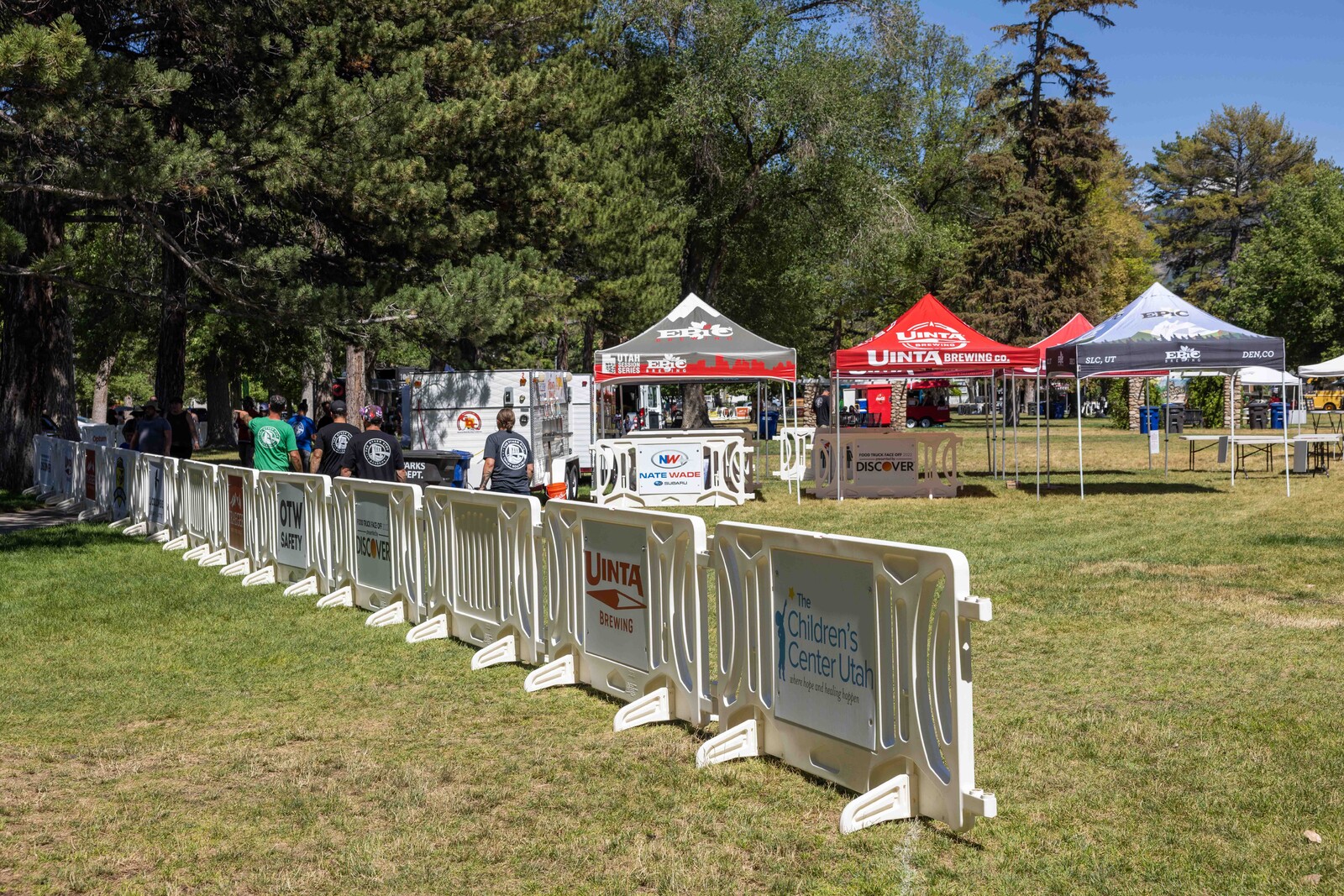
High-density polyethylene (HDPE) plastic crowd control barricades are the most versatile option for summer event crowd management. They’re lightweight, easy to deploy and reposition, interlock, and are available in multiple colors for zone coding. They can be used for stage fronts, perimeter control, VIP separation, and general guidance and pathways for attendee flow.
Water-filled traffic barricades (also manufactured from HDPE) are the right choice for vehicle exclusion zones, drop-off and pickup areas, and anywhere active traffic and pedestrians share proximity. Vertical panels also work well for this type of application. Interlocking steel barricades (also known as bike rack barricades) can serve many of the same functions as plastic barricades, but are a less recommended choice for outdoor summer events. Steel absorbs and radiates heat, which can be uncomfortable for attendees in close contact. Exposed edges and connection points can also create injury risk in high-pressure crowd situations.
Temporary event fencing panels can be the right tool for full perimeter enclosure and stricter access control. They’re taller, harder to breach, and better suited for multi-day events or overnight closures where the perimeter needs to be secured after hours. They can be ordered as standalone fencing or paired with HDPE barricades, such as OTW’s Barricade Fence Panels.
Stanchions and rope barriers can work well for queue management and controlled-entry lanes where the crowd is orderly, and the goal is direction rather than containment.
For a full comparison of barrier types and applications, see types of safety barriers.
Your 7-Step Crowd Control Planning Checklist for Summer Events
Work through these steps in order. Each one builds on the last – skipping ahead creates gaps you’ll find at the worst possible time.
Step 1: Define Your Event Zones and Crowd Flow
Before you order a single barricade, you need a site map that shows where people will be and how they’ll move. This is the foundation of your entire summer event crowd control plan.
- Map all entry and exit points, stage areas, vendor zones, walkways, restroom clusters, and emergency corridors
- Identify high-density areas where crowd pressure is most likely to build – places like stage fronts, entry gates, and concession areas are the most common pressure points
- Plan separate entry and exit routes wherever possible. Bidirectional crowd flow through the same gate is one of the fastest ways to create a bottleneck
- Mark every restricted zone that requires physical barricade separation from the general public: backstage, production areas, VIP sections, and staff-only corridors
Your site map becomes the reference document for every other step in this checklist. Keep it updated as the layout evolves and distribute the final version to all department leads before setup begins.
Step 2: Plan Barricade Placement for Emergency Access
Every event safety planning decision gets stress-tested in an emergency. Your barricade layout needs to support rapid evacuation, not obstruct it.
- Emergency corridors must remain clear and unobstructed at all times – no barricades, no equipment, no vendor overflow
- Coordinate barricade layout with your local fire marshal and EMS before finalizing the site plan. Their width and clearance requirements are non-negotiable and must be reflected in the submitted permit documents
- Gates in emergency corridors must be designed for rapid removal or swing-out without tools. Test them during setup, not during an evacuation
- Mark all emergency access routes clearly on your site map and brief every department or volunteer lead – not just security – on the evacuation corridor locations
If emergency responders can’t get in, or attendees can’t get out, every other element of your crowd control plan is irrelevant.
Step 3: Obtain Permits and Confirm Compliance
Crowd control planning for summer events isn’t just an operational decision – it’s a compliance requirement. Most municipalities require a documented event safety plan as part of the permit application.
- Confirm local ordinances for temporary event fencing, public assembly, and noise before finalizing your layout. Requirements vary by city and county
- Most permitting authorities require a site map that shows barricade and barrier placement. Submit this with your application and update it if the layout changes before the event
- Some venues require proof of barricade equipment certifications or compliance documentation. Request this from your supplier before the event if needed
Get permit approval in writing and keep a copy on site. If an inspector arrives during setup or during the event, you want documentation immediately available
Step 4: Account for Summer-Specific Hazards
Summer event crowd control has variables that don’t show up at indoor or cold-weather events. Plan for them specifically, not generically.
- Heat and sun exposure change crowd behavior over the course of the day. Crowds become less patient, more irritable, and more likely to push in dense areas as temperatures rise. Building rest areas and hydration stations into your crowd flow layout enhances the guest experience and keeps them safer. When stops like these are planned as destinations, crowd density is also distributed more evenly.
- Afternoon or evening thunderstorms are a predictable risk at most summer outdoor events. Have a documented shelter and evacuation plan that covers how barricades will be managed during a weather hold and how attendees will move to shelter without creating dangerous bottlenecks
- Rain softens the ground, and soft ground destabilizes barricades. If your venue has grass or unpaved surfaces, plan to use weighted or staked bases on perimeter runs – especially for festival barricades on stage fronts where crowd pressure is highest
- Staff stamina degrades in heat. Schedule rotation breaks, assign shade-adjacent posts where possible, and plan for reduced responsiveness in the late afternoon hours when both staff and crowd fatigue peak
Step 5: Calculate the Right Number of Barricades
Running short on crowd control barricades mid-setup is a problem that’s entirely preventable. It’s far better to have additional barricades on hand, in the case that they become necessary, than to discover a shortage the day of the event. Working zone by zone and then calculating the total footage needed can help ensure that no area of the event is lacking the necessary barricades.
- Measure total linear footage for each zone separately: perimeter, stage front, VIP area, queue lines, vehicle exclusion zones, and any other zone you’ve designated, depending on your event
- Divide each zone’s footage by your chosen barricade panel width. Choosing OTW Safety Billboard Barricades would mean that you divide your square footage by 8 feet (96 inches) to determine the proper number of barricades per zone. Don’t forget to confirm the panel width with your supplier before calculating!
- Add a 10–15% overage buffer across the total for corners, gate transitions, and last-minute layout changes
- Stage fronts, if stages are present, require continuous interlocking barricades with no gaps – plan these separately from perimeter runs
- Don’t treat the event as one unit. If you’re running a festival with a main stage, secondary stage, VIP zone, and vendor village, you’ve got four distinct barricade needs, not one
Once you’ve checked and double checked your numbers and put in your order, you’re one step closer to having an event properly prepared for crowd management.
Step 6: Coordinate with Security and Event Staff
Barricades define the physical structure of your event crowd management plan. Staff make it function in real time. The two need to be well coordinated before the event – not improvised day of.
- Assign specific staff to each barrier zone with clearly defined roles: monitoring crowd density, managing gate access, and flagging pressure build-up to supervisors
- Conduct a full pre-event walkthrough with security leads, venue management, and department heads. Walk the perimeter, walk the stage front, walk the emergency corridors. Everyone should physically see the layout before crowds arrive
- Establish radio communication protocols specifically for crowd control incidents. Who calls the alert? Who authorizes a barricade move? Who coordinates with EMS? Define these chains before the event, not during it
- Brief all staff on barricade removal procedures for emergencies. Anyone working a gate or perimeter zone needs to know how to open or remove a section safely and quickly
Step 7: Inspect and Set Up Equipment on Day of Event
Setup day is when plans meet reality! A thorough equipment inspection before gates open catches the problems that can’t be fixed once the crowd has arrived.
- Verify all barricade connections are secure and interlocking pins are fully engaged. A barricade that looks connected but isn’t will fail under crowd pressure
- Check every barricade, gate, and sign for damage, bends, or instability before placement. While you hopefully don’t encounter any damaged equipment, it does happen. It’s best to set any questionable pieces aside and replace them rather than risk any part of your crowd management failing under pressure
- Confirm all gate placements match the approved site plan. Deviations need to be documented and, if significant, reported to the permitting authority
- Walk the full perimeter once setup is complete. The walkthrough isn’t optional – it’s where you catch gaps, misaligned sections, and blocked emergency corridors before they become problems
Plan for setup to take longer than you expect. Rushing setup, especially the crowd management element, is how connections get missed and emergency corridors get compromised. Take the time necessary to smooth out snags before guests arrive so that you can be confident in your safety plan.
Common Crowd Control Mistakes at Summer Events
The most common event crowd management failures follow predictable patterns. Knowing them in advance is the easiest way to avoid them. Here are five to be aware of:
- Underestimating crowd size and under-ordering. Ticket counts don’t capture walk-ups, comp tickets, and late additions. Order based on your maximum capacity estimate, not your best-case scenario.
- Blocking emergency access routes with barricades. It happens when layout decisions are made without fire marshal input. Get that coordination done in Step two, not after permits are submitted.
- No plan for barricade repositioning during the event. Crowd dynamics shift: pressure builds in unexpected areas, weather changes crowd flow, and acts run long. Have extra staff and extra barricades staged for mid-event adjustments.
- Failing to account for weather-related ground softness. A perimeter that holds at setup may have tipped sections by the afternoon if it rained overnight. Weighted or staked bases eliminate this variable.
- Insufficient staff assigned to high-pressure zones. Stage fronts and entry gates are where crowd control barriers for events fail when no one is monitoring pressure and communicating density changes to supervisors.
Full Crowd Control Planning Checklist for Summer Events
Before your event opens, confirm that your checklist is finalized. The one below covers the essentials highlighted in this blog – add your own must-do’s to complete the list. This is your pre-event sign-off list!
- Event zones and crowd flow are mapped with entry, exit, high-density areas, and restricted zones identified
- Barricade quantity calculated zone by zone with a 10–15% overage buffer
- Emergency corridors identified, protected, and coordinated with the fire marshal and EMS
- Summer hazards (heat, afternoon weather, soft ground) are addressed in the layout and staffing plan
- Security and staff roles are assigned to each barrier zone, with communication protocols established
- Permits submitted with a site map showing barricade and barrier placement
- Equipment inspected for damage and all connections verified before gates open
- Evacuation and barricade removal procedures were briefed to all staff
- Extra barricades staged on site for mid-event repositioning
How OTW Safety Supports Event and Festival Crowd Control
OTW Safety offers interlocking crowd control barricades, temporary fencing panels, and water-filled barricades for events of all sizes – from neighborhood festivals to large-scale multi-day concerts. Our Billboard Barricade is our comprehensive concert and event barricade, and our other crowd control products supplement them perfectly. For heavy duty perimeter or traffic control needs, you can find our largest barricades and our temporary fencing here. (Not sure what you need? We can help!)
Products are designed for rapid deployment, easy transport, and secure interlocking connections that hold under crowd pressure. Our Billboard Barricades, in particular, are suitable for concerts, festivals, marathons, fairs, parades, and sporting events – any application where crowd flow guidance, zone separation, or perimeter control is required.
Whether you need festival barricades for a single weekend event or a full seasonal inventory for a recurring venue, OTW Safety can help you match the right equipment to your crowd control plan.
Frequently Asked Questions
What type of barrier is best for a festival stage front?
Interlocking plastic crowd control barricades are the preferred choice for festival stage fronts in the heat of summer. They connect end-to-end to create a continuous barrier, they’re stable enough to handle sustained crowd pressure, and their smooth surface reduces injury risk compared to steel alternatives. For high-capacity shows with significant crowd pressure against the barrier line, use ballasted or weighted bases.
How many crowd control barricades do I need for my event?
Measure the total linear footage for each zone separately, divide it by your barricade panel width (typically 6.5–8 feet, depending on the manufacturer), and add a 10–15% buffer for corners, gates, and adjustments. Don’t calculate the entire event as a single number – stage fronts, perimeters, VIP areas, and queue lines each have different density requirements and need to be calculated independently.
Are crowd control barricades required for outdoor summer events?
Requirements vary by municipality and venue. Most cities require a crowd control/safety plan as part of the event permit application, and many specify minimum barricade standards for public assembly events above a certain attendance threshold. Contact your local fire marshal and permitting authority early in the planning process to confirm what’s required for your specific event size and location.
What’s the difference between crowd control barricades and temporary fencing?
Crowd control barricades are designed for active crowd management: directing flow, separating zones, and creating stage fronts. They set up fast, move easily, and are intended for situations where the layout may need to change. Temporary event fencing is designed for full perimeter enclosure and hard access control. It’s taller, more difficult to bypass, and better suited for multi-day events or overnight closures. Most large outdoor festivals use both – fencing for the outer perimeter and barricades for interior flow and stage areas.
How do I plan for crowd control at a last-minute or pop-up event?
Start with your zone map, even if it’s rough: entry and exit points, the stage or focal area, and any restricted zones. Calculate a conservative barricade count based on expected attendance, add a 15–20% buffer since you won’t have time to re-order, and prioritize emergency corridor clearance above everything else. Contact your local permitting authority immediately to determine what documentation is required. For last-minute events, having a documented crowd control plan – even a simplified one – is significantly better than having none.
The Bottom Line
A complete crowd control planning checklist for summer events isn’t just a logistics tool: it’s a safety document, a permit requirement, and a liability management record. The seven steps in this checklist cover every phase from initial zone mapping to day-of equipment inspection, and each one matters.
Plan early, calculate zone by zone, coordinate with your local permitting and emergency services contacts, and order more than you think you need. The events that run smoothly aren’t the ones where nothing went wrong, they’re the ones where the planning accounted for what could have and took proactive measures.
When you’re ready to source crowd control barriers for your event, OTW Safety is here to help. See the full range of our event barricade solutions, explore our Quick Shop for fast, easy orders, or contact us for a comprehensive quote and expert advice.