How to Choose the Right Barricade for High-Speed Construction Zones
Not all work zones are equal, and neither are the barricades that protect them. In low-speed residential projects, the stakes for a misplaced or undersized barricade are different and generally far less severe than on an active freeway corridor moving traffic at 65 mph. The physics alone change the equation – and so do the federal standards.
Choosing the right barricade for a high-speed construction zone isn’t about picking the most expensive on the market, the cheapest option, or the first one you can find. It’s about knowing what MUTCD requires, understanding how crash performance and visibility work at the speed vehicles are moving, and matching those requirements to the specific conditions of your project.
This guide covers everything you need to make that decision with confidence.
What Is a High-Speed Construction Zone?
A high-speed construction zone is any roadway work zone with a posted speed of 45 mph or higher. That threshold matters because it’s where federal standards escalate – both for the equipment you’re required to use and for how that equipment has to perform if struck.
High-speed zones present unique hazards that lower-speed zones don’t. Drivers have less time to react, impact forces are exponentially higher, and a barricade that tips or fails in a 45+ mph environment doesn’t just create a citation – it becomes a projectile.
Common high-speed work zone environments include:
- Interstate and freeway construction corridors
- State highway lane closures and lane shifts
- Bridge and overpass work on high-speed roadways
- Utility and pavement projects on arterial roads with 45+ mph limits
MUTCD and state DOT standards govern what traffic control equipment is required in these environments. The baseline for compliant construction zone traffic barricades in high-speed zones is higher than most contractors assume.
Why Barricade Choice Matters in High-Speed Zones
The wrong barricade in a high-speed environment isn’t just a compliance problem; it’s a safety failure waiting to happen.
At higher posted speeds, vehicle impact force increases dramatically. A barricade that performs adequately at 25 mph can become a hazard at 65 mph. Barricades that tip easily in turbulent conditions from passing traffic create gaps in the work zone perimeter. Devices without proper retroreflectivity are harder to see, giving drivers less time to react, and equipment that hasn’t been crash-tested to the required standard may deflect off workers or other vehicles on impact.
Choosing the correct high-speed work zone barricades protects three things: your workers, the drivers passing through the zone, and your project. A stop-work order issued over non-compliant equipment stops all three from moving forward.
Federal Standards That Apply to High-Speed Zone Barricades
Two federal frameworks govern barricade selection for high-speed construction zones.
MUTCD Requirements
The Manual on Uniform Traffic Control Devices (MUTCD) is the primary standard for work zone traffic control in the US. For high-speed applications, MUTCD establishes:
- Approved barricade types – Type III barricades are the minimum required for road closures and high-speed work zones
- Retroreflectivity minimums for all rail panels
- Visibility and lighting standards, including requirements for nighttime operations
- Taper and buffer zone spacing requirements based on posted speed
State DOTs may adopt additional requirements in addition to the MUTCD. Always verify your state’s current standard before procurement, as requirements can vary, and some states are stricter than the federal baseline.
MASH Crash Testing
The MASH framework outlines test levels corresponding to specific impact conditions, ranging from low-speed urban environments to high-speed interstate conditions for barricades, guardrails, sign supports, and work zone devices. TL-1 crash testing covers low-speed conditions, generally for residential areas, with each test level increasing slightly in the assigned maximum speed and vehicle type, up to TL-6 (interstate speeds and large trucks).
For work zones with posted speeds of 45 mph or higher, the Federal Highway Administration (FHWA) requires longitudinal channelizing devices (LCDs) or any barricade protecting highway construction perimeters to meet MASH crash test requirements at Test Level 3 (TL-3). This is the MASH benchmark at which the rating shifts from moderate to high speed. TL-3 testing simulates the impact from a 1,800-lb vehicle traveling at 62 mph and a 5,000-lb pickup at 62 mph. Devices that pass this standard are designed to redirect, rather than penetrate or become projectiles on impact. That distinction is critical when workers are on the other side.
Always review crashworthiness documentation before specifying any barricade as an LCD in a high-speed zone, as the proper MASH rating is essential for protecting crews and construction sites.
(NCHRP-350-certified barricades manufactured before December 31, 2019, are being phased out quickly, but remain allowable until their prescribed end-of-use date, which varies by state and situation.)
Types of Barricades Used in High-Speed Construction Zones
Not every type of barricade is approved for high-speed applications. Here’s how the main approved options break down.
Type III Barricades
The Type III barricade is the MUTCD-required standard for road closures and high-speed work zones. It features three horizontal rails – more than Type I or Type II – which increase vertical visibility and make it easier for drivers to recognize the work zone boundary from greater distances. Type III barricades must also have full-panel retroreflective sheeting in orange and white alternating stripes on the rails. They are the minimum required construction barricades for most high-speed zone applications.
Water-Filled Plastic Barricades
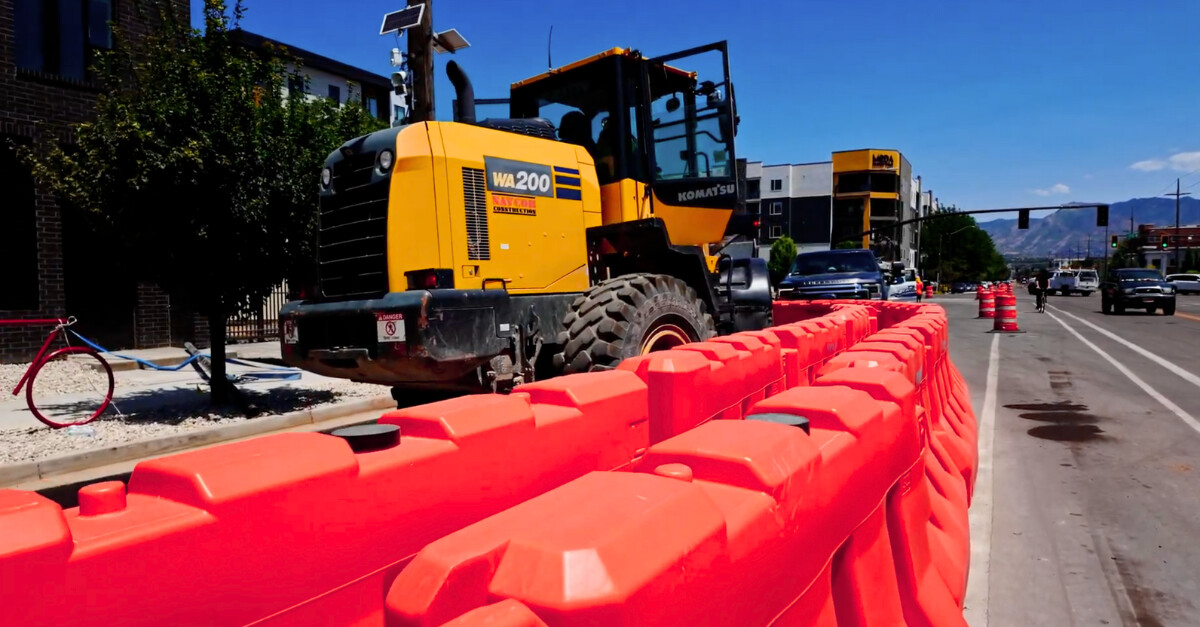
Plastic water-filled barricades offer greater mass and stability than standard Type III barricades. When used as perimeters or longitudinal channelizing devices (LCDs) in high-speed zones, they must meet MASH TL-3 crash test requirements.
Their fillable, jersey-shape design allows field ballasting to increase stability without adding permanent weight to transport. They’re commonly used in longer-duration lane closures and on high-volume highways where additional worker separation is a priority.
Concrete Jersey Shape Barriers
Precast concrete barriers are the heaviest and most robust option. They’re best suited for semi-permanent or long-duration projects where the zone footprint won’t change frequently. Like plastic barriers, they must meet MASH TL-3 crash testing.
Their weight makes repositioning time-consuming and equipment-dependent, so they’re not the right choice for short-duration closures or projects with shifting zone boundaries.
Supplemental Channeling Devices
Drums, cones, and vertical panels are supplemental devices – they guide traffic within and approaching the work zone but do not replace barricades for road closures or primary work zone boundaries. In high-speed environments, drums and weighted vertical panels are generally preferred over cones due to their greater visibility and stability.
Visibility Requirements for High-Speed Zone Barricades
Visibility at high speed is a function of retroreflectivity, color contrast, and advance distance. A driver at 65 mph covers nearly 100 feet per second, so your barricades need to be seen far enough in advance to give drivers time to react, merge, and slow down safely.
MUTCD-compliant barricades for high-speed zones must meet these visibility standards:
- High-contrast orange and white alternating striping on all rail panels
- Retroreflective sheeting on every rail
- Retroreflectivity levels that meet MUTCD minimum performance requirements
- Visible at an adequate advance distance for the posted speed – the higher the speed, the further away they must be visible
Retroreflective sheeting degrades over time and under UV exposure, so it’s best to inspect panels regularly and replace sheeting that has faded, cracked, or delaminated. A barricade that was compliant at installation may not be compliant six months later without maintenance.
In some high-speed applications, flags or additional advance-warning signage may be required (in addition to barricades) to achieve an adequate advance-warning distance.
Lighting Requirements for Night and Low-Visibility Conditions
Retroreflectivity alone isn’t enough for nighttime operations. MUTCD requires active warning lights on barricades in high-speed zones during nighttime and low-visibility conditions.
Common lighting configurations for highway construction barriers include steady-burning amber lights for stationary work zones, flashing amber lights for active or moving operations, solar-powered units that recharge during the day and operate automatically at night, and battery-operated units where solar exposure is limited.
Lights must remain functional throughout the entire shift. That requires a pre-shift inspection of every unit, replacement of dead batteries, and verification that solar panels are clean and oriented correctly.
A barricade with a dead warning light is a non-compliant barricade. In a nighttime high-speed environment, it’s also a hazard.
Crashworthiness and Impact Performance
When specifying roadway construction barricades for high-speed zones, crashworthiness documentation isn’t optional; it’s a procurement requirement on most DOT projects.
MASH TL-3 testing verifies that a device, when struck at highway speeds, will redirect rather than penetrate or fragment dangerously. Key performance criteria include:
- The device must not create secondary hazards to workers or other drivers on impact
- Lightweight designs that redirect on impact reduce injury risk compared to rigid alternatives
- Ballasted or anchored bases improve pre-impact stability without increasing hazard on impact
Before specifying any barricade as a longitudinal channelizing device in a 45+ mph zone, request the crashworthiness test documentation from the manufacturer and verify it matches the application. Not all crash-tested devices are tested under the same conditions or at the same test levels.
Wind and Weather Stability Considerations
High-speed traffic generates significant turbulence. At highway speeds, the wake from a passing semi-truck can exert enough lateral force to tip a lightweight barricade with an undersized base. In open highway environments, wind compounds the problem.
When evaluating barricades for high-speed construction zones, stability in turbulence and adverse weather is as important as compliance with MUTCD type. Look for:
- Wide, low-profile bases that resist tipping under lateral loads
- Interlocking or chainable designs that allow a continuous, linked perimeter line
- Ballast options – sand or water fill – that increase base mass without a permanent weight penalty during transport
- Wind-rated configurations certified by the manufacturer for open highway environments
A barricade that tips in turbulence creates a gap in the work zone perimeter, which can lead to cars crossing where they shouldn’t, accidents, and more. In a high-speed environment, that gap is immediately visible to approaching drivers – and the downed barricade is now a road hazard.
Spacing and Placement Guidelines for High-Speed Zones
Compliant equipment placed incorrectly is still non-compliant. MUTCD provides specific taper and buffer zone requirements that vary based on posted speed, and high-speed zones require tighter, more frequent placement than lower-speed applications.
Key placement principles for barricades in high-speed construction zones:
- Follow MUTCD taper table requirements for the posted speed – taper lengths increase significantly as speed increases
- Maintain a continuous, unambiguous work zone boundary with no visible gaps between barricades
- Use closer spacing intervals in the taper and transition zones compared to open-road segments
- Coordinate all barricade placement with the approved traffic control plan – field placement must match the TCP
If the work zone footprint changes during the project, the TCP must be updated, and the barricade placement adjusted to match. Inspectors look for consistency between the plan and the field, and any inconsistencies are violations.
Common Violations in High-Speed Construction Zones
The most frequent errors once barricades and safety equipment are set up aren’t random – they fall into predictable patterns. Here’s what to watch for:
- Using Type I or Type II barricades where Type III is required. Fewer rails mean less visibility. In a high-speed zone, this is a MUTCD violation from the moment the barricade goes up.
- Inadequate retroreflectivity. A lack of reflective panels renders a barricade non-compliant from the start. When a barricade does have the required panels, it’s essential to maintain it. Faded panels don’t meet the standard, even if the barricade type is correct. Retroreflectivity must be verified and maintained throughout the project to remain compliant.
- Missing or non-functioning warning lights. A barricade without working lights during nighttime operations is non-compliant and hazardous. Ensuring that the barricades can support hazard lighting is essential, and, once installed, a pre-shift inspection is required to ensure everything is in working order.
- Improper spacing or taper length. Using the wrong spacing table for the posted speed is one of the most common compliance failures found during DOT inspections.
- Failure to account for wind and vehicle turbulence. Lightweight barricades with narrow bases will tip, so plan for turbulence and ballast accordingly.
- Using non-crash-tested equipment as longitudinal channelizing devices or perimeters. If a device isn’t MASH TL-3 tested, it cannot be used as an LCD in a high-speed zone.
Features to Look for in a High-Speed Zone Barricade
When comparing construction zone traffic barricades for high-speed applications, prioritize these features:
- Type III three-rail configuration for maximum vertical visibility
- Full-panel retroreflective sheeting in orange and white on every rail
- Compatible warning light mount – secure, accessible, and compatible with standard amber warning lights
- Durable, UV-resistant materials that maintain retroreflectivity and structural integrity over extended field exposure
- Stable, weighted, or interlocking base designed for vehicle turbulence
- Easy transport and rapid deployment to reduce setup time and the opportunity for configuration errors
Not every barricade that claims compliance with MUTCD or MASH is built to perform equally well in a high-speed environment. Verify the specs, request documentation, and evaluate the base design before your first order.
How to Evaluate a Barricade for Your High-Speed Project
Before committing to any barricade for a high-speed construction zone, run through this evaluation:
- Verify MUTCD type and MASH TL rating. Type III barricades are required for most, if not all, high-speed road closures and primary work zone boundaries. MASH TL-3-certified barricades are also required in high-speed areas. Confirm the device actually meets this standard, and isn’t just stamped with a general “compliant” claim.
- Check retroreflectivity compliance. Confirm sheeting type and performance level, and assess the current panel condition if the equipment has been in service.
- Assess base stability. Consider site-specific wind exposure, traffic speed and volume, and whether ballasting is available and practical.
- Confirm lighting compatibility. Verify that the barricade has a mount for the required warning light type and that lights can be installed securely.
- Review crashworthiness documentation. Request TL-3 test reports if the barricade will be used as an LCD, and verify the test conditions match your application.
- Confirm availability for the project duration. Equipment shortages mid-project create gaps – order with enough lead time to avoid substitution pressure.
How OTW Safety Supports High-Speed Construction Zone Safety
OTW Safety offers highway construction barricades and safety products designed specifically for high-visibility, high-speed environments. The lineup includes our 42″ Jersey Shape LCD Barricade, the 32” Compact Jersey Shape Barricade, the Vertical Panel, and our Type A/C Bi-Directional Hazard Light, among others. OTW Safety’s newest TL-3-tested 42” LCD barricades – those manufactured after 2019 – are MASH-compliant under the most recent guidelines, and the older models will be grandfathered in until re-testing is required for all. This 42” jersey shape LCD is built for use as a longitudinal channelizing device in 45+ mph zones where crash performance is a requirement, not an option. (Looking for something else? Browse our construction traffic barricades to see the full lineup.)
OTW Safety products are built for:
- MUTCD compliance across barricade type, retroreflectivity, and lighting standards
- NCHRP-350 TL-3 testing for many products that are compliant under the most recent MASH guidelines
- Durability and weather resistance under extended highway field exposure
- Ease of setup, repositioning, and maintenance to reduce the opportunity for configuration errors
Many of our products are suitable for highway and freeway construction, DOT projects, and contractor and municipal applications where work zone safety is non-negotiable.
For more on barrier types and which applications they’re suited for, see types of safety barriers.
Quick Barricade Selection Checklist for High-Speed Zones
Before your equipment order goes out, confirm each of the following:
- Type III barricade configuration confirmed for all primary work zone boundaries
- Retroreflective sheeting meets MUTCD minimums on every rail panel
- Warning lights installed and functional for nighttime and low-visibility operations
- Base is stable for site wind exposure and vehicle turbulence at the posted speed
- Crashworthiness documentation reviewed for any device used as an LCD
- Placement follows the approved traffic control plan with correct taper and spacing
- Equipment inspection schedule established and documented
Frequently Asked Questions
What type of barricade is required in high-speed construction zones?
Type III barricades are the MUTCD-required standard for road closures and high-speed work zones. Water-filled barricades and concrete jersey shape barriers are also used, particularly where longitudinal channelizing device crash performance is required. All LCD applications in 45+ mph zones require MASH TL-3 crash-tested equipment.
Do high-speed zone barricades need lighting?
Yes. Warning lights are required during nighttime and low-visibility conditions in high-speed work zones. Steady-burning or flashing amber lights – solar or battery-powered – must be mounted on barricades and remain functional throughout every shift.
What is the MUTCD?
The Manual on Uniform Traffic Control Devices is the federal standard that governs traffic control in work zones across the US. It specifies barricade types, retroreflectivity minimums, lighting requirements, and taper and spacing standards. State DOTs adopt MUTCD and may add their own requirements on top of it.
Can I use low-speed traffic barricades on a highway project?
No. Highway construction zones require barricades that meet higher standards for visibility, stability, and crashworthiness than standard low-speed barricades. Using Type I or Type II barricades where Type III is required is a MUTCD violation. Using an uncrash-tested device as an LCD in a 45+ mph zone violates FHWA requirements.
What happens if barricades don’t meet requirements?
Non-compliant equipment can result in OSHA or DOT fines, stop-work orders, and increased liability exposure if an incident occurs. Inspectors who find inconsistencies between the traffic control plan and the field setup can halt work immediately until the deficiency is corrected.
What is MASH TL-3 testing?
MASH TL-3 (Manual for Assessing Safety Hardware, Test Level 3) is the crash-performance standard required for longitudinal channelizing devices in high-speed work zones. TL-3 testing simulates vehicle impacts at highway speeds. Devices that pass are verified to redirect on impact rather than become projectiles or penetrate the work zone.
The Bottom Line
Choosing the right barricade for a high-speed construction zone comes down to three things: meeting MUTCD type requirements, verifying crash performance for any device used as an LCD (including perimeters and end caps), and maintaining visibility standards throughout the life of the project.
The right barricades with full-panel retroreflective sheeting, working warning lights, and stable bases built for vehicle turbulence aren’t optional in 45+ mph environments – they’re the baseline. Getting that baseline right from day one is far less expensive than correcting it after an inspection or an incident, so ensure that your barricade choice covers all required elements to maintain compliance.
When you’re ready to specify equipment for your next high-speed project, OTW Safety can help you match the right barricade to your application.