Temporary Traffic Control Devices: Choosing the Right Equipment for Your Jobsite
Temporary traffic control devices are selected by posted speed, project duration, road type, and proximity to live traffic — not by preference or availability. MUTCD Guidance calls for Type I or Type III barricades on high-speed roads (and TypeIII to close a road).Barriers are required where vehicles need to be physically stopped or redirected. Get those two things right and most TTC compliance problems don’t happen.
Choosing the right temporary traffic control devices for a jobsite isn’t complicated — but it does require matching equipment to specific conditions. The wrong device for the application creates safety gaps, compliance exposure, and the kind of setup that gets flagged on inspection. This guide covers the MUTCD categories of temporary traffic control devices, how to select equipment based on jobsite conditions, and the most common selection mistakes that cause problems on active projects.
What Are Temporary Traffic Control Devices?
The Department of Transportation’s manual on the topic defines temporary traffic control (TTC) devices as:
“All signs, signals, markings, channelizing devices, or other devices that use colors, shapes, symbols, words, sounds, or tactile information for the primary purpose of communicating a regulatory, warning, or guidance message to road users on a street, highway, pedestrian facility, bikeway, pathway, or site roadway open to public travel.”
Naturally, the TTCs serve three core functions: warn drivers of upcoming conditions, guide traffic through or around the work zone, and channelize movement. This is to keep drivers, workers, bikers, and pedestrians safe as a roadway is under construction.
The TTC devices you use need to match specific hazards, road types, posted speeds, and duration of the work zone. Every jobsite is different and there is no one-size-fits-all setup, so careful planning (and the right equipment) are essential to the safety of your crew and passerbys For example, a cone-and-sign arrangement may be appropriate for a two-hour utility repair on a residential street, but it is not appropriate for an overnight highway lane closure.
In the MUTCD Part 6 manual on Temporary Traffic Control Devices, The DoT has set forth strict standards for color, retroreflectivity, and placement. So you’re better prepared to meet these safety standards, let’s explore the categories of TTC devices.
MUTCD Categories of Temporary Traffic Control Devices
The MUTCD Part 6 manual organizes temporary traffic control devices into five primary categories. Understanding what each category does (and what it doesn’t do) is going to be key in sourcing the right safety solutions for your job-site.
#1. Signs — Signs grab attention and set expectations of an upcoming work zone. Advance warning, regulatory, and guide signs help the drivers know what’s coming and set the required reaction window. Spacing and sequencing regulations set by the MUTCD help drivers react properly to the changing roadway.
#2 Channelizing devices —Cones, drums, tubular markers, and vertical panels define lane boundaries and direct traffic flow through the work zone. These define lane boundaries and direct traffic flow and spacing varied depending on posted speed limits.
#3 Barricades — A subtype of channeling devices: barricades, close, restrict, or delineate. All are part of the roadway to protect the work zone Type I, II, and III barricades serve different applications based on road type and speed. Type III is the most often necessary type for road closures and high-speed zones.
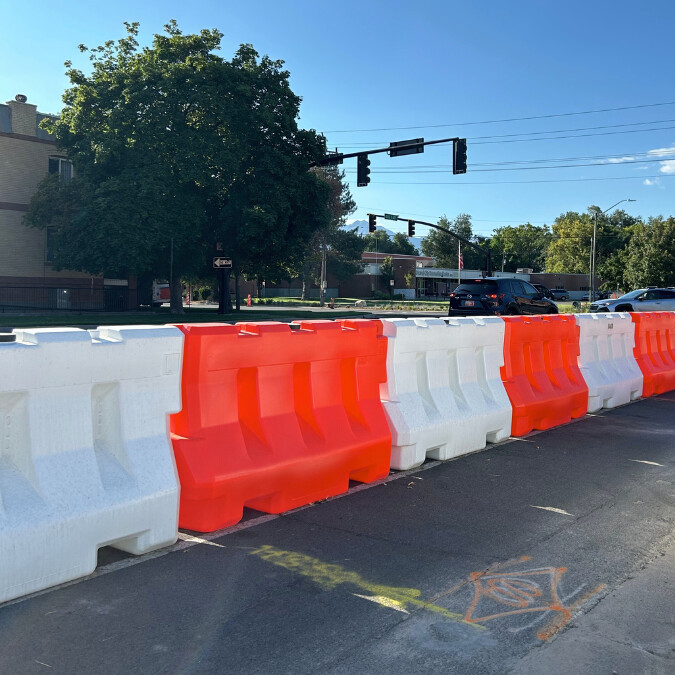
#4 Temporary traffic barriers — water-filled or concrete longitudinal barriers provide physical separation between traffic and workers. These are not interchangeable with any barricade. A barricade marks a boundary, while a barrier stops a vehicle, but linking together LCD Barricades form a barrier for this purpose.
#5 Warning lights — These are necessary on barricades and channelizing equipment during nighttime and low-visibility operations. A non-functional warning light on an active barricade is a compliance violation and must be replaced immediately.
How to Match Devices to Your Jobsite Conditions
Speed Limits Determine Device Types Required — Speed is the first thing to look at. The MUTCD delineates slow speed and high speed around 45 miles per hour. In slow-speed zones type I devices may be perfect, while above you’ll need type II or III to maintain compliance and a safe job-site. High speeds require more robust equipment, greater advance warning distances, and MASH-tested barriers.
Project duration drives a second set of decisions. Short-duration work under an hour typically needs only properly sequenced cones and signs. Work running hours to days requires barricades, drums, and temporary signs. Long-term projects require a full traffic control plan with Type III barricades, barriers where applicable, lighting, and TCP documentation kept current throughout the project.
Proximity to live traffic determines whether barriers are needed in addition to channelizing devices. If workers are operating adjacent to travel lanes with no physical buffer, channelizing devices alone are not sufficient protection. Nighttime operations require channelizing devices to be retroreflective for visibility, and warning lights may be added in low-visibility conditions such as fog or snow. Always plan for these visibility requirements before finalizing your equipment list.
Barricade Type Selection: Type I, II, and III Explained
The three MUTCD barricade types serve different applications. Selecting the wrong type creates both a safety gap and a compliance violation.
- Type I — the most basic configuration, lowest visibility profile (minimum rail length 24 inches). The MUTCD states Type 1 barricades may be used on conventional roads or urban streets.
- Type II — a more visible configuration (minimum rail length 24 inches). Type 1 or Type 2 barricades are intended for situations where road-user flow is maintained through the zone, and the MUTCD’s guidance is that Type 2 (or Type 3) should be used on freeways, expressways, and other high-speed roads.
- Type III — the largest, highest-visibility configuration (minimum rail length 48 inches; on high-speed roads, expressways, and freeways a minimum of 270 square inches of retroreflective area is required). The MUTCD’s guidance recommends Type 3 barricades to close or partially close a road (§6K.07). Note this is guidance (“should”), not an absolute “shall.”
When your unsure and the site allows it, specifying Type III is a conservative choice for high-speed and closure work. You’ll just want to confirm it fits the space. Type III meets the standard in every situation where Type I or II would also be acceptable, and the cost difference is minimal compared to the exposure from a non-compliance citation. See construction traffic barricades for Type III options rated for highway and DOT applications.
When to Use Temporary Traffic Barriers Instead of Barricades
Barricades guide traffic but are not designed to stop a vehicle on impact. That distinction matters on high-speed projects.
Temporary barriers — water-filled, plastic, or concrete jersey shape — are required when physical protection from errant vehicles is needed. Common applications include separating workers from live highway traffic, protecting fixed equipment near travel lanes, and vehicle exclusion zones adjacent to active operations.
Barriers used as longitudinal channelizing devices (LCDs) in 45+ mph zones must meet MASH or NCHRP-350 TL-3 crash-test requirements. Non-crash-tested equipment in that application is non-compliant regardless of what a product listing says. We recommend you request and retain crash-test certification documentation before equipment reaches the jobsite.
For a full breakdown by application, see types of safety barriers.
Common Temporary Traffic Control Device Mistakes
Most TTC compliance failures come from a short list of recurring selection and setup errors:
- Wrong device type. Using Type I or Type II barricades where the MUTCD’s guidance calls for Type II or Type III (high-speed roads) or Type 3 (road closures)
- Skipping the taper. Merging lanes abruptly without a channelized approach is dangerous and non-compliant; taper length is not optional
- Missing or non-functional warning lights. Missing retroreflectorization at night, or a non-functional device where the plan relies on it — any device in the approved plan that is no longer serviceable must be replaced.
- Specifying temporary traffic barriers for positive protection without verifying MASH crash-test certification (typically TL-3 for high-speed applications)
Quick Device Selection Checklist:
- Posted speed confirmed, and device types match MUTCD requirements for that speed
- Taper length calculated from MUTCD tables for the road type and speed
- Barricade type selected, ensuring you haveType II or III for high-speed roads, and Type III to close or partially close a road.
- Physical barrier specified where worker separation from live traffic is required
- Warning lights installed and functional for nighttime or low-visibility operations
- Traffic control plan current and posted on-site
- All equipment MUTCD-compliant and, where applicable, MASH-tested
How OTW Safety Supports Traffic Control Equipment Selection
OTW Safety offers MUTCD-compliant Type III barricades, water-filled barriers, and TTC equipment for highway, municipal, and DOT projects. The 42″ MASH TL-3 crash-tested Barrier provides the crash-worthy positive protection needed for high-speed construction zones where physical separation from live traffic is required. Products are designed for fast deployment, durability under field conditions, and easy compliance with visibility and lighting requirements.
- Construction Traffic Barricades
- Highway Construction Barricades
- Types of Safety Barriers
- Costly Work Zone Safety Mistakes That Delay Construction Projects
Frequently Asked Questions
What is the difference between a Type I, II, and III barricade?
The MUTCD labels them Type I, II, and III. Type I is the most basic configuration and may be used on conventional roads or urban streets. Type I or Type II barricades are intended where road-user flow is maintained through the zone. The MUTCD’s guidance recommends Type II or Type III on freeways, expressways, and other high-speed roads, and Type III to close or partially close a road. Verify the requirement against your project specification and state DOT.
When is a traffic barrier required instead of a barricade?
When the application calls for physical protection from errant vehicles. Barricades are not designed to stop vehicle impact. The MUTCD directs that positive protection, meaning a crash-worthy temporary traffic barrier, be considered when workers are exposed to live traffic on long-term stationary projects at operating speeds of 45 mph or greater with high volumes or near roadside hazards such as drop-offs. Barriers providing that protection in high-speed zones are typically MASH TL-3 crash-tested.
What MUTCD standard applies to temporary traffic control devices?
MUTCD Part 6 governs temporary traffic control devices. It sets standards for device types, placement, retroreflectivity, spacing, taper lengths, buffer zones, and lighting requirements. State DOTs may adopt additional requirements on top of the federal baseline — always verify the applicable standard for the specific jurisdiction before finalizing the TCP.
Do temporary traffic control devices need to be crash-tested?
Not all of them. Barriers used as longitudinal channelizing devices (LCDs) in zones with posted speeds above 45 mph must meet MASH or NCHRP-350 TL-3 crash-test requirements. Standard barricades used for boundary marking and channelization in lower-speed applications are not subject to the same crash-test mandate. When in doubt, request certification documentation from the supplier and verify against the project specification.
How do I calculate the correct taper length for my work zone?
Taper length is calculated using MUTCD Table 6C-3, which provides formulas based on posted speed and the width of the lane shift or closure. For speeds at or below 45 mph: L = WS (where L = taper length in feet, W = width of offset in feet, S = speed in mph). For speeds above 45 mph: L = WS²/60. Your state DOT may specify modified values — verify before finalizing the TCP.
Temporary traffic control device selection comes down to four variables: posted speed, project duration, proximity to live traffic, and lighting conditions. Match the equipment to those conditions, specify Type III barricades for high-speed and closure applications, use crash-tested barriers where physical separation is required, and keep the traffic control plan current.
OTW Safety carries MUTCD-compliant TTC equipment for highway, municipal, and DOT applications. When you’re ready to spec the right devices for your next project, OTW Safety is here to help.