March 2026 Safety Roundup

This blog series serves as a monthly highlight of recent news/updates in the safety industry, including airport, construction, events, and general safety news.
To keep you informed about recent and current safety highlights, we’ve compiled updates and national stories here to keep you up to date on all things safety.
This month, we’ll highlight Pennsylvania’s solution for enhanced traffic and highway safety, the top 10 most dangerous jobs in America, the National Safety Council’s prediction for the decrease in U.S. traffic fatalities, and more.
Table of Contents
1 – A ‘commonsense approach to enhance safety’: Pennsylvania adds truck parking spaces
2 – The Top 10 Most Dangerous Jobs in America: Is Yours on the List?
3 – National Safety Council Projects 12% Decrease in U.S. Traffic Fatalities in 2025
4 – Construction safety doesn’t have a compliance problem, it has a confidence problem
5 – Navigating the New ADA Title II Digital Accessibility Rule: What Airports Need to Know
6 – Senate committee agrees on need for federal safety standards for automated vehicles
A ‘commonsense approach to enhance safety’: Pennsylvania adds truck parking spaces
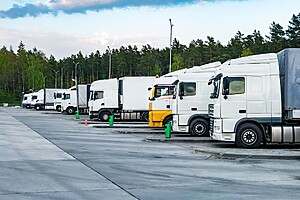
When driving long distances, it’s common for fatigued truck drivers to find any place they can to pull off the road so they can take a break and get some rest (which, in turn, does make the roads safer). Unfortunately, this often means they can be found on road shoulders, near exit ramps, and more, which can still be dangerous for other motorists. Pennsylvania DOT is seeking to remedy this by adding more semi-truck parking spaces in safe locations statewide, starting with 339 new spaces at 24 locations. The intended plan is to reach 1,200 spaces by the end of 2026.
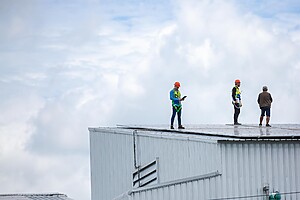
The Top 10 Most Dangerous Jobs in America: Is Yours on the List? | ISHN
The Bureau of Labor Statistics (BLS) recently released its 2024 data concerning the number of fatalities and injuries on the job. While there was a decrease in the total number of deaths from occupational accidents, one person still loses their life every 104 minutes. The fatality rate, which the BLS calculates as the number of fatal workplace injuries per 100,000 full-time equivalent (FTE) workers, dropped to 3.3% in 2024, but the numbers still remain higher than they should. This article covers the top 10 most dangerous jobs, and the first three mentioned are logging workers, fishing and hunting workers, and roofers, which account for 98.9, 86.9, and 51.8 deaths per 100,000 FTE workers.
National Safety Council Projects 12% Decrease in U.S. Traffic Fatalities in 2025
Recent analysis from the National Safety Council estimates a 12% decrease in motor vehicle deaths in 2025 from 2024. These numbers reflect the efforts of initiatives like those that the Road to Zero Coalition works toward. In partnership with the U.S. Department of Transportation, the Road to Zero Coalition is working toward a nation with zero roadway deaths. The Safe System Approach, one of several initiatives by the NSC and the U.S. DOT, focuses on five key elements to decrease roadway danger: safer roads, safer speeds, safer people, safer vehicles, and better post-crash care. With continued success in the Safe System Approach, preventable traffic fatalities may continue to decrease.

Construction safety doesn’t have a compliance problem, it has a confidence problem
While regulations are more stringent than ever, and while businesses that wish to stay aboveboard generally comply with them to the letter, there’s often still a missing link between compliance and actual safety on the jobsite. In cases where safety isn’t prioritized, or in other cases where paperwork decreases the time available to spend executing projects, compliance and the flow of work can become disconnected. Paper processes still maintain preeminence as the main reporting and compliance method, but the need for physical paperwork can often decrease response time in critical situations. Construction Today suggests a safety and productivity platform that changes the way that sites operate from start to finish and strengthens safety culture.
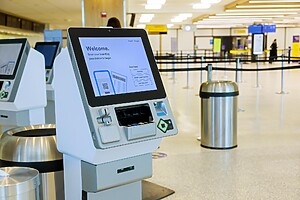
Navigating the New ADA Title II Digital Accessibility Rule: What Airports Need to Know
Accessibility has long been a challenge for those who require it, but the Department of Justice’s (DOJ) recent ruling under the Americans with Disabilities Act (ADA) Title II will expand accessibility regarding public entities and their digital services. Airports in particular are required to be in full compliance by April 24, 2026, in regard to their websites, operating systems, multimedia applications, mobile applications, and more. This includes elements like auditing each of these entities to ensure that they are accessible on every level, with appropriate aids like captions, audio descriptions, and other accessibility options. This will be an in-depth process as airports and other public entities seek to achieve and maintain compliance in the months and years to come.

Senate committee agrees on need for federal safety standards for automated vehicles
Autonomous vehicles have descended on the roadways of the United States, and AV robotaxi pioneers Waymo and Tesla have urged Congress to set and regulate federal safety standards for all automated vehicles, as standards currently differ greatly across states, and global competition is heating up. Tesla has encouraged this route as the way to maintain America’s position in global technological development, and is urging Congress to allow and equip the National Highway Traffic Safety Administration (NHTSA) to provide the needed framework for regulations. Many in Congress support the need for federal regulations concerning automated vehicles, but others see the robotaxis as encroaching on the jobs of human taxi and rideshare drivers. A recent hearing brought all of this information to Congress, but it remains to be seen what legislation will make it through both the House and the Senate.
OTW News
Contact us to order a crowd control weight
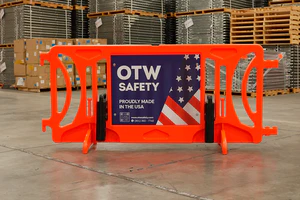
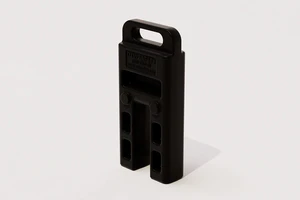
We’ve been developing a new accessory for the classic Billboard Barricade: the perfect complement to our Billboard Barricade (CC42x96), the Crowd Control Hanging Weight (CC-H-WEIGHT-18). When sandbags or water aren’t an option, the crowd control weight slides on easily without tools or hardware. Once in place, 18 lbs of durable rubber ballast lowers the center of gravity and secures the barricade against movement—without changing its footprint or overall look.