Exclusion Zone Barricades for Large-Scale Construction Site Pedestrian Safety

In this article, we’ll help you think through exclusion zones and the safety equipment used to establish them on a large-scale construction site. A safe, incident-free day depends on many things working together. It takes planning, forethought, and coordination to help everyone get home safely. Exclusion zones and pedestrian safety are just one part of construction site safety planning, but an essential one nonetheless.
Why do large-scale construction sites need to keep pedestrian safety a top priority?
On a normal job site, pedestrian safety is more straightforward, with good teamwork, simple hazard identification, and safety-aware workers, it’s achievable with the right tools on hand and enough forethought. But whenever the number of workers on site increases for a large-scale build (like a data center where as many as 1,500 workers could be on site at peak work hours), pedestrian and equipment separation becomes that much more of a priority. These sites can be beehives of activity for 12 to 18 months while trades stack on top of each other.
What the MUTCD Has to say about pedestrian safety on construction sites
As these hundreds of people are making their way through the job site every day (and are busy with their work), they’re usually looking for the shortest reasonable routes, whether they’re heading to a break, a delivery, or their next task. The MUTCD puts it this way (Section 6D.01): “It must be recognized that pedestrians are reluctant to retrace their steps to a prior intersection for a crossing or to add distance or out-of-the-way travel to a destination.”
Even the most cautious worker can’t memorize a hazard set that gets redistributed at every phase change. The MUTCD makes a similar point regarding drivers navigating changing job sites (Section 6D.03): “TTC zones present temporary and constantly changing conditions that are unexpected by the road user. This creates an even higher degree of vulnerability for workers on or near the roadway.”
Where worker education and safety awareness alone are not sufficient, physical separation is essential to keep all workers safe on foot. This is why pedestrian safety is such a high priority for large-scale construction sites. Construction site safety officers need to do pedestrian and equipment separation, internal traffic control, work zone delineation, and erect exclusion zones to keep people safe.
Why are struck-by accidents such a danger on construction sites?
Struck-by incidents, which include being struck by a vehicle or equipment, struck by a falling object, struck by a swinging or suspended load, and struck by flying material, are the leading cause of nonfatal injuries in construction and the second most common cause of fatalities among construction workers, according to NIOSH. Approximately 75% of struck-by fatalities involve heavy equipment such as trucks or cranes.
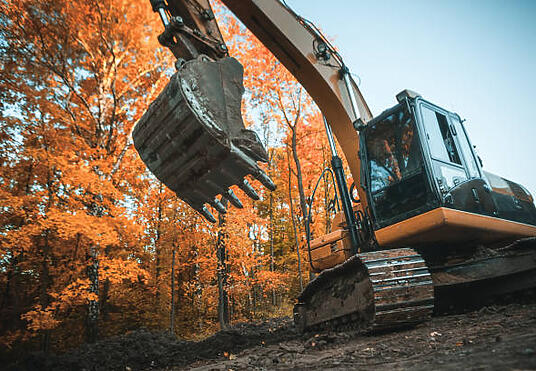
Operators of large machinery, such as an excavator, have significant blind spots. One of the hardest things about struck-by incidents is that the hazard is less predictable than a fixed hazard such as a fall. On a large job site your exposure to struck-by hazards is continuous, whether you’re walking on a break or completing a task.
Which construction zones need exclusion zone barricades?
Always follow applicable regulations and local requirements, and apply conservative judgment when identifying hazards or establishing exclusion zones. This list is not exhaustive, but it covers some of the zones that come up most:
- the property line, where the public passes adjacent to active construction
- areas beneath suspended loads and active lifting operations
- openings or equipment left unattended overnight
- walking routes that share ground with equipment
- areas below overhead work or staged materials
- energized gear and arc flash boundaries
- open excavations and pits
- crane swing radius
- restricted zones
For each of these, decide how you’ll delineate and separate the hazard from the people on foot.
What kind of barricade protects workers on large-scale construction sites?
You’re going to want to look for a barricade that clearly identifies hazards and blocks off restricted areas, but is also efficient and easy to use, such that it is going to be consistently and reliably used by workers on the ground. You want to make sure it’s light enough to reposition, easy to store, easy to deploy.
On a large construction site, the 32″ Jersey Shape Barricade can help identify work areas and lay out pedestrian routes, while the 42″ Jersey Shape LCD is the best option for applications that call for an LCD in a higher-speed work zone. Both interlock to form a continuous line.
Where you need a taller boundary, Barricade Fence Panels can be added to compatible barricades. For a line that is primarily for directing pedestrians, and you need clear messaging, the Billboard Barricade can carry custom signs and is perfect for directing foot traffic.
Get expert help with barricades and safety equipment with OTW Safety
OTW Safety has been providing barricades and safety equipment for over 30 years. We’re committed to excellent products, of course, but we’re especially passionate about making sure that you have what you need when you need it. We offer direct-to-manufacturer pricing and freight logistics, which come with:
- Same-day business quotes
- 99% on-time fulfillment
- 60-day price lock guarantee on product and freight
- Access to real people when you need them (We answer our phones!)
We would love to play a small part in helping you pull off your large-scale construction site project and do it safely.
Call OTW at 801-285-9457 or shop construction traffic barricades.
More resources: Data center construction barricades | Billboard Barricade | Crowd control products | Water-filled barriers | Reducing common hazards on construction sites