Safety Barriers versus Safety Barricades – What’s the Difference?

At OTW Safety, we talk frequently about barriers and barricades (they’re one thing we’re experts in, after all), but have you ever wondered what the difference is between the two or if there is a difference to begin with?
Many would consider them to be the same thing, and, while the effect is often the same or similar when either is deployed and the words are often used interchangeably, the objects themselves technically differ.
According to Merriam-Webster, these two words have similar, albeit different, meanings. A barrier is defined as “something material that blocks or is intended to block passage” while a barricade is defined as “an obstruction or rampart thrown up across a way or passage to check the advance of opposing forces”.
OSHA, on the other hand, defines them in their safety and health regulations for construction as such: a barricade is “a physical obstruction such as tapes, cones, or A-frame type wood or metal [or plastic] structures that provides a warning about, and limits access to, a hazardous area”, while a barrier is “a physical obstruction that prevents contact with energized lines or equipment or prevents unauthorized access to a work area”. In the safety field, OSHA’s definitions are especially important, as the use of barricades and barriers alike are consistently found as safety requirements in construction, traffic control, warehouse work, and more.
What are barricades and barriers used for?
Barricades hinder entrance or passage to specific areas.
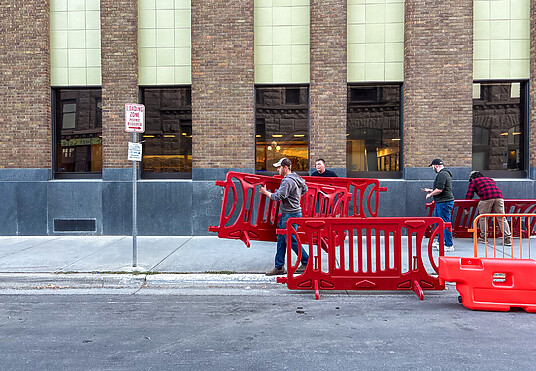
The most common type of barricade is a well-known one – a fence. Whether chain-link or made of metal or another material, fences and other types of barricades (such as A-frame or foldable barricades) are intended to bar passage to any given site or thoroughfare, or to separate one area from another. Gates, plastic blockades, and even caution tape can also fall within the barricade category. Often, just like a backyard fence, barricades are permanent or semi-permanent structures, but can also be temporary.
Barriers are most commonly used for different types of defense.
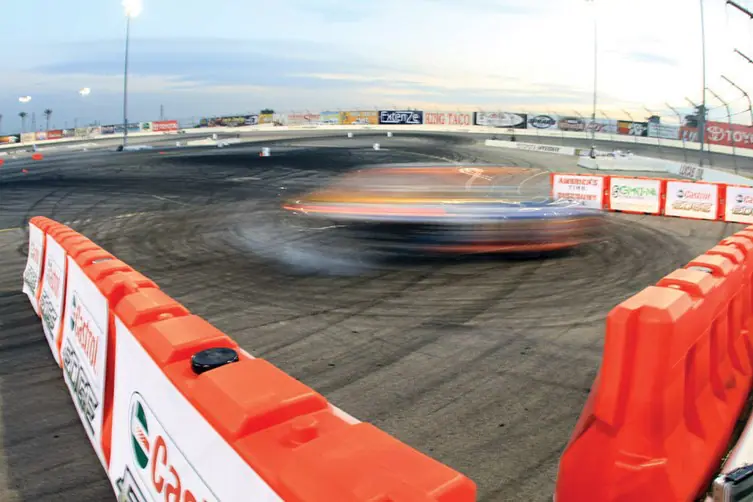
When you hear the word “barrier”, you likely think of a construction site or a long line of orange and white lining the freeway. OSHA requires the use of barriers in most, if not all, sites because hazards are present at an exponential rate, so it’s a fair assumption to make. In situations where barriers are deployed, they are almost always present as defense or deflection against hazards, whether for workers or pedestrians. Barriers are used as a division on busy streets or high-speed freeways/highways between construction and traffic, and can also be found encircling hazards such as holes in the ground, heavy equipment, and areas with live electricity. As these hazards or sites are generally temporary, so is the assembly of barriers that enclose them.
Yet both can be multipurpose.
Because both barricades and barriers can be used for a variety of overlapping applications, the general assumption that the words mean the same thing is valid. While barricades are generally used to halt passage or direct people in a certain direction, barriers can also serve this purpose – especially in crowd control, where patrons and guests need to be prevented from wandering the wrong way or entering places they shouldn’t. This also applies to work sites when barricades are used as the perimeter in order to protect the site from unauthorized personnel, animals, and those with ill intent, or when barriers and barricades are integrated together to form one cohesive unit (such as our barricade fence panels paired with our 42” jersey-shaped barricades). When it comes down to it, it’s as much about the intent of usage as the object itself that determines whether it is a “barrier” or a “barricade”.

What types of barriers and barricades does OTW manufacture?
In terms of barriers versus barricades, OTW manufactures what we call plastic barricades, but they can, as mentioned above, be used in such a wide range of applications that we use both words when describing our products!
Our Jersey-shaped (JSS) barricades are most commonly used for construction, while the longitudinal-channelizing device (LCD) barricade is most often found in the midst of traffic or high-speed areas where repairs or new development are taking place.
For crowd control, we recommend our trusty billboard barricades, which are specifically designed with pedestrian safety in mind. Airport barricades, like the 10” low-profile barricade, ensure that the airfield is the safest it can be, defending the tarmac against hazards created by and around moving aircraft.
Either way, OTW’s commitment to safety endures.
Whether your business or site needs barriers, barricades, or additional safety accessories, OTW has you covered when it comes to creating a safe workplace.
Visit our product pages to learn more about each barricade that we offer. Contact us today at (801) 363-7740 or email orders@otwsafety.com to request a quote.